


News

2026.10.19
Many enterprises have already built monitoring centers, control rooms, or command centers to centrally manage operations across multiple sites. However, as video feeds, IoT devices, access control systems, and operational data continue to grow, bringing information into one place no longer guarantees greater management efficiency.
Operators still need to switch between different systems to search for and compare information. When an incident occurs, the response often depends on manual assessment, which takes time and may delay critical action.
Enterprises therefore need more than new command center equipment. They need an AI-Powered Command Center with system integration, intelligent analytics, and decision-support capabilities.
This article compares traditional and AI-powered command centers and explains how enterprises can modernize their operations step by step while retaining existing equipment.
01|What Is the Difference Between a Traditional and an AI-Powered Command Center?
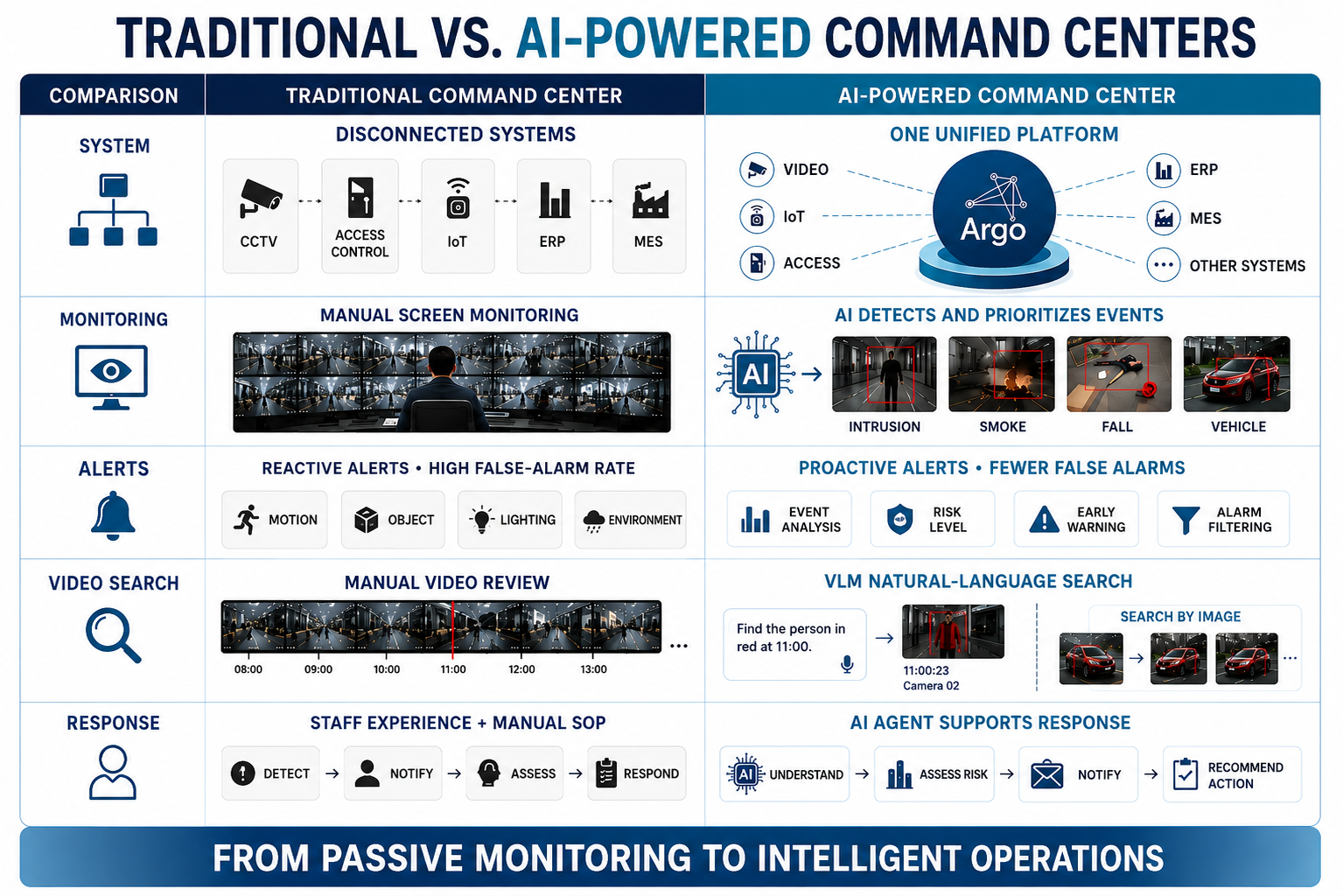
A traditional enterprise command center mainly displays video feeds and device information in one place.
An AI-powered command center goes further by connecting video, IoT devices, access control systems, and operational data. AI helps analyze events, generate proactive alerts, and support decision-making—moving operations from simply seeing an event to understanding what is happening.
02|Three Common Challenges of Command Center Modernization
When planning a command center upgrade, enterprises often face three practical challenges.
1. High Existing Infrastructure Investment
Many facilities already have hundreds of fully operational IP cameras and NVRs. Replacing all of them with AI cameras would require a significant budget and a large-scale installation project, making approval difficult.
2. Incompatible Systems from Multiple Vendors
Video surveillance may come from one vendor, access control from another, and SCADA from a third. Because these systems do not share data, operators must constantly switch between different screens and software applications.
3. Information Overload and Alert Fatigue
Traditional motion detection can be triggered by changes in lighting, weather, animals, and other irrelevant activity. Hundreds of false alarms each day can lead to alert fatigue, increasing the risk that a critical event will be overlooked.
03|How Can Enterprises Add AI Without Replacing Existing Equipment?
Building an AI-powered command center does not require enterprises to rebuild their entire surveillance system. An open architecture and AI technologies can gradually add intelligence to existing infrastructure.
Step 1|Connect Existing Devices and Third-Party Systems
Keep existing cameras, NVRs, and network infrastructure.
A platform that supports standard protocols such as ONVIF and RTSP, along with open APIs and SDKs, can connect video surveillance, access control, fire alarm systems, IoT devices, and other third-party systems through one management interface.
Step 2|Add Edge AI to Existing Cameras
Deploy Edge AI computing devices in critical areas to analyze video from existing cameras.
Without replacing front-end devices, enterprises can add AI capabilities such as:
- Person detection and recognition
- PPE compliance detection
- Smoke and fire detection
- License plate recognition
- Other AI video analytics
Step 3|Enable VLM Video Search and Proactive Alerts
With a Vision-Language Model (VLM), operators can search video using natural language.
For example:
- “Find the person wearing a red shirt yesterday.”
- “Show workers who were not wearing safety helmets.”
The system can quickly locate relevant video and combine the results with proactive AI alerts, reducing manual search time and improving incident response.
Step 4|Build a Digital Twin Operations Platform
Enterprises can then add a Digital Twin and operational dashboards to connect CCTV, IoT sensors, AI analytics, ERP, MES, ESG, and other business data.
Managers can use a single interface to monitor site conditions and operational performance, improving cross-department collaboration and decision-making.
04|The Value of an AI-Powered Command Center Is Integration, Not Replacement
Many enterprises assume that adopting AI requires replacing all existing equipment. In reality, the key is integration, not replacement.
With an open architecture, enterprises can retain their existing surveillance infrastructure while gradually adding AI, IoT, VLM, and Digital Twin capabilities.
This turns fragmented video and operational information into data that can be analyzed, searched, and used for decision-making, while reducing implementation costs and the risks associated with equipment replacement.
Built on an open architecture, Spark’s Argo AI VMS integrates video surveillance, IoT, Edge AI, VLM, AI assistants, and Digital Twin applications.
It helps enterprises modernize existing systems step by step and build a scalable AI-Powered Command Center.
Many enterprises have already built monitoring centers, control rooms, or command centers to centrally manage operations across multiple sites. However, as video feeds, IoT devices, access control systems, and operational data continue to grow, bringing information into one place no longer guarantees greater management efficiency.
Operators still need to switch between different systems to search for and compare information. When an incident occurs, the response often depends on manual assessment, which takes time and may delay critical action.
Enterprises therefore need more than new command center equipment. They need an AI-Powered Command Center with system integration, intelligent analytics, and decision-support capabilities.
This article compares traditional and AI-powered command centers and explains how enterprises can modernize their operations step by step while retaining existing equipment.
01|What Is the Difference Between a Traditional and an AI-Powered Command Center?
A traditional enterprise command center mainly displays video feeds and device information in one place.
An AI-powered command center goes further by connecting video, IoT devices, access control systems, and operational data. AI helps analyze events, generate proactive alerts, and support decision-making—moving operations from simply seeing an event to understanding what is happening.
02|Three Common Challenges of Command Center Modernization
When planning a command center upgrade, enterprises often face three practical challenges.
1. High Existing Infrastructure Investment
Many facilities already have hundreds of fully operational IP cameras and NVRs. Replacing all of them with AI cameras would require a significant budget and a large-scale installation project, making approval difficult.
2. Incompatible Systems from Multiple Vendors
Video surveillance may come from one vendor, access control from another, and SCADA from a third. Because these systems do not share data, operators must constantly switch between different screens and software applications.
3. Information Overload and Alert Fatigue
Traditional motion detection can be triggered by changes in lighting, weather, animals, and other irrelevant activity. Hundreds of false alarms each day can lead to alert fatigue, increasing the risk that a critical event will be overlooked.
03|How Can Enterprises Add AI Without Replacing Existing Equipment?
Building an AI-powered command center does not require enterprises to rebuild their entire surveillance system. An open architecture and AI technologies can gradually add intelligence to existing infrastructure.
Step 1|Connect Existing Devices and Third-Party Systems
Keep existing cameras, NVRs, and network infrastructure.
A platform that supports standard protocols such as ONVIF and RTSP, along with open APIs and SDKs, can connect video surveillance, access control, fire alarm systems, IoT devices, and other third-party systems through one management interface.
Step 2|Add Edge AI to Existing Cameras
Deploy Edge AI computing devices in critical areas to analyze video from existing cameras.
Without replacing front-end devices, enterprises can add AI capabilities such as:
- Person detection and recognition
- PPE compliance detection
- Smoke and fire detection
- License plate recognition
- Other AI video analytics
Step 3|Enable VLM Video Search and Proactive Alerts
With a Vision-Language Model (VLM), operators can search video using natural language.
For example:
- “Find the person wearing a red shirt yesterday.”
- “Show workers who were not wearing safety helmets.”
The system can quickly locate relevant video and combine the results with proactive AI alerts, reducing manual search time and improving incident response.
Step 4|Build a Digital Twin Operations Platform
Enterprises can then add a Digital Twin and operational dashboards to connect CCTV, IoT sensors, AI analytics, ERP, MES, ESG, and other business data.
Managers can use a single interface to monitor site conditions and operational performance, improving cross-department collaboration and decision-making.
04|The Value of an AI-Powered Command Center Is Integration, Not Replacement
Many enterprises assume that adopting AI requires replacing all existing equipment. In reality, the key is integration, not replacement.
With an open architecture, enterprises can retain their existing surveillance infrastructure while gradually adding AI, IoT, VLM, and Digital Twin capabilities.
This turns fragmented video and operational information into data that can be analyzed, searched, and used for decision-making, while reducing implementation costs and the risks associated with equipment replacement.
Built on an open architecture, Spark’s Argo AI VMS integrates video surveillance, IoT, Edge AI, VLM, AI assistants, and Digital Twin applications.
It helps enterprises modernize existing systems step by step and build a scalable AI-Powered Command Center.