


News

2026.05.13
How AI-Powered ALPR Systems Are Transforming Parking, Security, and Smart City Operations
As smart cities, commercial properties, and digital parking infrastructure continue to expand worldwide, License Plate Recognition (LPR), also referred to as Automatic License Plate Recognition (ALPR), has evolved beyond simple gate access into a critical technology for smart mobility and security.
Powered by Artificial Intelligence (AI), Optical Character Recognition (OCR), and deep learning, modern LPR systems can identify license plates in real time while integrating with access control, parking management, traffic analytics, incident alerts, and centralized video platforms.
For businesses, implementing LPR is no longer just a security upgrade—it's a strategic investment in operational efficiency, data visibility, and smarter facility management.
1. What Is License Plate Recognition (LPR)?
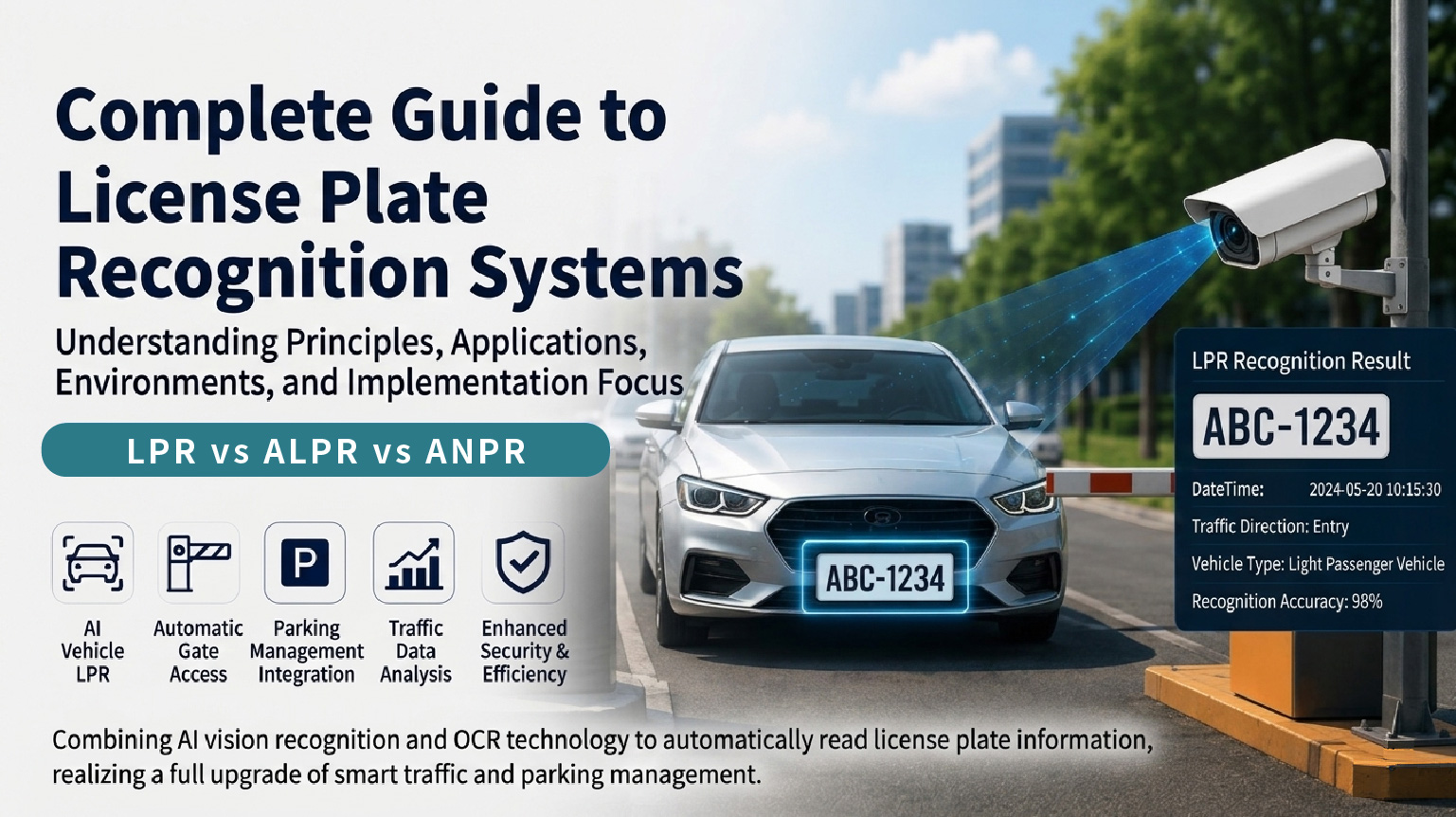
License Plate Recognition (LPR) is an AI-powered video analytics technology that automatically detects vehicles and extracts license plate information from live video streams or recorded footage.
By combining computer vision with OCR technology, an LPR system can automatically capture and process vehicle data without human intervention.
Typical LPR functions include:
- Automatic license plate reading and recording
- Vehicle entry and exit timestamp logging
- Vehicle image capture and storage
- Whitelist and blacklist matching
- Real-time alerts for unauthorized vehicles
- Searchable historical vehicle records
Compared with traditional RFID cards, remote controls, or manual registration, LPR technology offers faster vehicle access, lower operating costs, and stronger security management.
2. How Does an LPR System Work?
A modern LPR solution typically consists of intelligent cameras, AI analytics engines, and a backend management platform.
The recognition workflow includes four key steps:
Step 1: Vehicle Detection
Using deep learning models, the system detects vehicles in real time, identifying vehicle position, direction, and type.
Step 2: License Plate Detection
AI algorithms precisely locate the license plate within the image, even under varying angles, distances, or complex backgrounds.
Step 3: OCR Character Recognition
OCR technology converts plate characters into structured digital data for search, reporting, and automation.
Step 4: Database Matching and Event Management
When integrated with platforms like Spark's Argo AI VMS, organizations can enable:
- Authorized vehicle access control
- Blacklist alerts
- Parking duration and billing automation
- Vehicle history lookup
- Incident investigation and reporting
3. LPR vs ALPR vs ANPR: What's the Difference?
Although LPR, ALPR, and ANPR essentially refer to the same core technology, the terminology varies by region.
| Term | Full Name | Common Markets | Description | ||||||
|---|---|---|---|---|---|---|---|---|---|
| LPR | License Plate Recognition | Global | Most commonly used general term | ||||||
| ALPR | Automatic License Plate Recognition | United States, Canada, Asia | Preferred in North America | ||||||
| ANPR | Automatic Number Plate Recognition | United Kingdom, Europe | Common in European markets |
For the U.S. market, ALPR is often the most searched term, while LPR remains widely used in enterprise security and parking industries.
4. Common Applications of LPR Systems
LPR technology is widely deployed across multiple industries.
-
Smart Parking Management

Automate ticketless parking, gate opening, parking fee calculation, and occupancy analytics.
Benefits include:
- Reduced wait times
- Improved parking turnover
- Lower staffing costs
- Better revenue visibility
- Residential Communities and Commercial Buildings
Automatically identify residents, visitors, and authorized vehicles while strengthening property security.

-
Manufacturing and Logistics Facilities
Manage fleet access, visitor registration, and delivery vehicle tracking.
-
Traffic Enforcement and Public Safety
Support traffic monitoring, law enforcement, stolen vehicle detection, and public safety operations.

5. What Affects License Plate Recognition Accuracy?
Under optimized deployment conditions, modern AI-powered LPR systems can achieve recognition accuracy of 95%–99%.
However, actual performance depends on several factors:
- Camera installation angle and heigh
- Lighting conditions and nighttime illumination
- Vehicle speed
- Plate dirt, obstruction, or glare
- Rain, fog, backlight, and weather conditions
- Camera resolution and shutter speed
This is why successful LPR deployment requires not only AI algorithms, but also proper camera design and system integration.
In real-world roadway monitoring projects in Taiwan, Spark's LPR solution has achieved recognition accuracy exceeding 97%.
6. How Much Does an Enterprise LPR System Cost?
The cost of an enterprise-grade LPR deployment typically includes:
- IP cameras and supplemental lighting
- Edge AI computing hardware
- LPR software licenses
- Video management platform integration
- Access control or parking system integration
- Installation, calibration, and operator training
Actual project costs vary depending on:
- Number of entrances and exits
- Vehicle traffic volume
- Required recognition speed
- Integration complexity
- Multi-site management requirements
7. 5 Key Questions Before Deploying an LPR System
Before investing in an LPR project, organizations should evaluate:
1. Is your lighting environment consistent?
Do you need 24/7 day-and-night recognition?
2. How fast are vehicles moving?
Do you require high-speed vehicle capture?
3. Do you manage multiple locations?
Will centralized management be necessary?
4. Do you need system integration?
Will the LPR platform connect with ERP, parking, access control, or third-party systems?
5. Do your deployment requirements include cybersecurity compliance or data sovereignty?
Do you need On-Premise deployment, private infrastructure, or compliance with government procurement standards?
Future-Proof Your Vehicle Access Strategy with AI-Powered LPR
As smart mobility, intelligent buildings, and physical security continue to evolve, LPR technology is becoming the foundation for:
- Security automation
- Operational efficiency
- Traffic intelligence
- Business analytics
- Scalable infrastructure
By combining AI vision technology with Argo AI VMS, Spark helps organizations build secure, scalable, and future-ready vehicle management systems.
Key capabilities include:
- Real-time AI-powered LPR recognition
- Multi-site centralized management
- Instant incident alerts
- Traffic and operational analytics
- On-premise deployment
- Open API integration with third-party platforms
For organizations seeking stronger security, greater operational efficiency, and deeper data visibility, LPR is no longer optional—it's essential.
How AI-Powered ALPR Systems Are Transforming Parking, Security, and Smart City Operations
As smart cities, commercial properties, and digital parking infrastructure continue to expand worldwide, License Plate Recognition (LPR), also referred to as Automatic License Plate Recognition (ALPR), has evolved beyond simple gate access into a critical technology for smart mobility and security.
Powered by Artificial Intelligence (AI), Optical Character Recognition (OCR), and deep learning, modern LPR systems can identify license plates in real time while integrating with access control, parking management, traffic analytics, incident alerts, and centralized video platforms.
For businesses, implementing LPR is no longer just a security upgrade—it's a strategic investment in operational efficiency, data visibility, and smarter facility management.
1. What Is License Plate Recognition (LPR)?
License Plate Recognition (LPR) is an AI-powered video analytics technology that automatically detects vehicles and extracts license plate information from live video streams or recorded footage.
By combining computer vision with OCR technology, an LPR system can automatically capture and process vehicle data without human intervention.
Typical LPR functions include:
- Automatic license plate reading and recording
- Vehicle entry and exit timestamp logging
- Vehicle image capture and storage
- Whitelist and blacklist matching
- Real-time alerts for unauthorized vehicles
- Searchable historical vehicle records
Compared with traditional RFID cards, remote controls, or manual registration, LPR technology offers faster vehicle access, lower operating costs, and stronger security management.
2. How Does an LPR System Work?
A modern LPR solution typically consists of intelligent cameras, AI analytics engines, and a backend management platform.
The recognition workflow includes four key steps:
Step 1: Vehicle Detection
Using deep learning models, the system detects vehicles in real time, identifying vehicle position, direction, and type.
Step 2: License Plate Detection
AI algorithms precisely locate the license plate within the image, even under varying angles, distances, or complex backgrounds.
Step 3: OCR Character Recognition
OCR technology converts plate characters into structured digital data for search, reporting, and automation.
Step 4: Database Matching and Event Management
When integrated with platforms like Spark's Argo AI VMS, organizations can enable:
- Authorized vehicle access control
- Blacklist alerts
- Parking duration and billing automation
- Vehicle history lookup
- Incident investigation and reporting
3. LPR vs ALPR vs ANPR: What's the Difference?
Although LPR, ALPR, and ANPR essentially refer to the same core technology, the terminology varies by region.
| Term | Full Name | Common Markets | Description | ||||||
|---|---|---|---|---|---|---|---|---|---|
| LPR | License Plate Recognition | Global | Most commonly used general term | ||||||
| ALPR | Automatic License Plate Recognition | United States, Canada, Asia | Preferred in North America | ||||||
| ANPR | Automatic Number Plate Recognition | United Kingdom, Europe | Common in European markets |
For the U.S. market, ALPR is often the most searched term, while LPR remains widely used in enterprise security and parking industries.
4. Common Applications of LPR Systems
LPR technology is widely deployed across multiple industries.
-
Smart Parking Management
Automate ticketless parking, gate opening, parking fee calculation, and occupancy analytics.
Benefits include:
- Reduced wait times
- Improved parking turnover
- Lower staffing costs
- Better revenue visibility
- Residential Communities and Commercial Buildings
Automatically identify residents, visitors, and authorized vehicles while strengthening property security.
-
Manufacturing and Logistics Facilities
Manage fleet access, visitor registration, and delivery vehicle tracking.
-
Traffic Enforcement and Public Safety
Support traffic monitoring, law enforcement, stolen vehicle detection, and public safety operations.
5. What Affects License Plate Recognition Accuracy?
Under optimized deployment conditions, modern AI-powered LPR systems can achieve recognition accuracy of 95%–99%.
However, actual performance depends on several factors:
- Camera installation angle and heigh
- Lighting conditions and nighttime illumination
- Vehicle speed
- Plate dirt, obstruction, or glare
- Rain, fog, backlight, and weather conditions
- Camera resolution and shutter speed
This is why successful LPR deployment requires not only AI algorithms, but also proper camera design and system integration.
In real-world roadway monitoring projects in Taiwan, Spark's LPR solution has achieved recognition accuracy exceeding 97%.
6. How Much Does an Enterprise LPR System Cost?
The cost of an enterprise-grade LPR deployment typically includes:
- IP cameras and supplemental lighting
- Edge AI computing hardware
- LPR software licenses
- Video management platform integration
- Access control or parking system integration
- Installation, calibration, and operator training
Actual project costs vary depending on:
- Number of entrances and exits
- Vehicle traffic volume
- Required recognition speed
- Integration complexity
- Multi-site management requirements
7. 5 Key Questions Before Deploying an LPR System
Before investing in an LPR project, organizations should evaluate:
1. Is your lighting environment consistent?
Do you need 24/7 day-and-night recognition?
2. How fast are vehicles moving?
Do you require high-speed vehicle capture?
3. Do you manage multiple locations?
Will centralized management be necessary?
4. Do you need system integration?
Will the LPR platform connect with ERP, parking, access control, or third-party systems?
5. Do your deployment requirements include cybersecurity compliance or data sovereignty?
Do you need On-Premise deployment, private infrastructure, or compliance with government procurement standards?
Future-Proof Your Vehicle Access Strategy with AI-Powered LPR
As smart mobility, intelligent buildings, and physical security continue to evolve, LPR technology is becoming the foundation for:
- Security automation
- Operational efficiency
- Traffic intelligence
- Business analytics
- Scalable infrastructure
By combining AI vision technology with Argo AI VMS, Spark helps organizations build secure, scalable, and future-ready vehicle management systems.
Key capabilities include:
- Real-time AI-powered LPR recognition
- Multi-site centralized management
- Instant incident alerts
- Traffic and operational analytics
- On-premise deployment
- Open API integration with third-party platforms
For organizations seeking stronger security, greater operational efficiency, and deeper data visibility, LPR is no longer optional—it's essential.